Le VPN Adds Post-Quantum Encryption to Protect Your Data
Le VPN adds a post-quantum key exchange to your VPN connection when you turn on the Quantum-safe switch. This post-quantum encryption stops an eavesdropper who copies your encrypted traffic today from decrypting it later.
An eavesdropper on the network can copy your encrypted traffic today and wait until a quantum computer is strong enough to decrypt it. With the switch on, Le VPN adds a fresh ML-KEM-768 secret, the NIST FIPS 203 standard, to every WireGuard and Stealth WireGuard connection, so a quantum computer alone can't open what such an attacker copied.
What is a "harvest now, decrypt later" attack?
Encrypted traffic is easy to copy. An eavesdropper watching the network between you and a server, for example on public Wi-Fi or a tapped cable, can save it, even if they can't read it. The bet is that the copy becomes readable years later, once a quantum computer can break the mathematics that protected the session.
NIST's transition report IR 8547, final since 27 October 2026, calls it "harvest now, decrypt later" and says migration must start today even if such computers are a decade away. The EU's coordinated roadmap of 11 June 2025 calls it "store now, decrypt later" and lists government data, sensitive personal data and trade secrets as examples. The UK's National Cyber Security Centre, in its whitepaper of 14 August 2024, describes an attacker collecting and storing data today to decrypt it in the future, and adds that such an attack is only likely to be worthwhile for very high-value information.
The WireGuard paper by Jason A. Donenfeld, first presented in 2017, says adversaries "may be recording encrypted traffic on a long term basis" in the hope of breaking Curve25519 later.
The EU roadmap treats data as high-risk if exposing it 10 years or more from now would still cause significant damage. Medical records, legal files, business plans and private messages can all pass that test.
Which part of a VPN connection can a quantum computer attack?
A VPN connection uses two kinds of cryptography. A key exchange runs first, so the app and the server agree on session keys. A symmetric cipher then uses those keys to encrypt your traffic. In WireGuard the key exchange is Curve25519 and the cipher is ChaCha20-Poly1305. OpenVPN and IKEv2 use AES-256 for the data.
The cipher is the strong part. NIST's post-quantum FAQ says it is quite likely that the known quantum attack on symmetric keys, Grover's algorithm, gives little or no advantage against AES, and that AES-192 and AES-256 will still be safe for a very long time even if quantum computers turn out much cheaper than expected. The NCSC says symmetric cryptography is "not significantly impacted by quantum computers". Neither agency names ChaCha20. Like AES-256, it uses a 256-bit key. Our guide to VPN encryption explains how these ciphers work.
The key exchange is the weak part. Elliptic-curve exchanges such as Curve25519 belong to the public-key family that a large quantum computer could break. If the exchange falls, the session keys fall with it, and so does the traffic an eavesdropper copied. NIST's report makes the same split. It says digital signatures "are not vulnerable" to harvest now, decrypt later, and that the threat has to be considered when setting the timeline for key establishment. Germany's BSI also names key agreement as the scheme mainly at risk.
The cipher can stay as it is. Le VPN changes the key exchange.
What does Le VPN add to your connection?
Before the tunnel starts, the app runs an ML-KEM-768 exchange with the server you chose. Both sides derive the same 256-bit secret from it. The app then brings up the real tunnel and mixes that secret into WireGuard as a preshared key for that connection.
The preshared key is a standard WireGuard option. The protocol description presents it as an added layer "for, say, post-quantum resistance". WireGuard sets it to all zeros by default, so WireGuard on its own is not post-quantum. Le VPN fills it with a key that comes from ML-KEM-768.
ML-KEM comes from FIPS 203, which NIST published on 13 August 2024. In the standard's words it is "believed to be secure, even against adversaries who possess a quantum computer". ML-KEM-768 sits in NIST's security category 3, rated at least as hard to break as a key search on AES-192, and NIST recommends it as the default parameter set.
This is a hybrid design. The classic Curve25519 exchange stays in place and ML-KEM-768 is added to it. An eavesdropper who copies the traffic would have to break both. The BSI recommends this combination of post-quantum and classical schemes where possible.
- The app makes the key when it connects to a server and renews it after 24 hours on a long session. A quick reconnect to the same server can reuse it.
- The key stays in memory only and is never written to a log.
- If the exchange fails or the server does not answer within 5 seconds, the app connects the classic way and shows no message.
Post-quantum encryption protects against an eavesdropper who copies traffic now and decrypts it later. It does not protect against an attacker who already owns a quantum computer and interferes at the moment you connect.
Which apps and protocols have it?
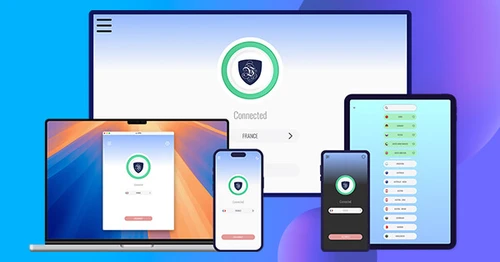
Quantum-safe covers WireGuard and Stealth WireGuard. It works in the Le VPN apps for Android phones and tablets, iPhone, iPad, Mac, Apple TV, Apple Vision Pro, Windows and Linux.
It does not cover OpenVPN or IKEv2.
The switch is called "Quantum-safe" and carries the hint "Protects today's traffic from being decrypted later by quantum computers." It has an atom icon.
| App | Where the switch is |
|---|---|
| Android phones and tablets | Protection tab, VPN settings card, just before Local Connections. It appears while a WireGuard protocol is selected. |
| iPhone and iPad | Protection tab, VPN settings card, just before Local Connections, with WireGuard or Stealth WireGuard selected. |
| Mac | Menu, VPN settings card, just before Local Connections. |
| Apple TV | Menu, QUANTUM-SAFE row. |
| Apple Vision Pro | Settings, Protection section, just before Local Connections. |
| Windows and Linux | Menu, VPN settings card, between Cryptographic ID and Local Connections. |
The switch is available to turn on now. A change applies at the next connection. The iPhone, iPad, Mac, Apple TV, Windows and Linux apps grey the switch out while the VPN is connected. The switch will reach every Le VPN app gradually, so it may not appear in all of them yet.
The Quantum-safe switch is live now in the apps downloaded from le-vpn.com: the Mac app, version 3.11.1, the Android app, version 3.11.1, and the Windows and Linux apps, version 3.6.0. If you already use one of them, you get it through the app's own update, or through your package manager on Linux. The iPhone, iPad and Mac App Store apps at version 3.11.0 are in review at Apple, and the Android app is in review at Google Play. Apps downloaded directly from le-vpn.com usually get new features a few days before the store versions, for people who want them first. You can get the current apps from the download page, including the Mac app and the Android app from le-vpn.com, and the post-quantum encryption page has the full feature description.
How is the rest of the industry moving?
Much of the web has already made this change, also in hybrid form.
- Browsers. Google turned on a hybrid post-quantum key exchange by default in Chrome 124 for desktop and named store now, decrypt later as the urgent reason.
- Web traffic. Cloudflare Radar shows that post-quantum key exchange protected 72.5% of human HTTPS requests to Cloudflare's network in the week of 17 to 24 November 2026. The figure covers traffic that Cloudflare serves, not the whole web.
- Messaging. Signal added a post-quantum algorithm alongside X25519 on 19 September 2023, so an attacker must break both. Apple announced PQ3 for iMessage on 21 February 2024 and shipped it with iOS 17.4.
- Remote access. OpenSSH 10.0, released on 9 April 2025, made a hybrid ML-KEM-768 and X25519 exchange the default. Version 10.1, released on 6 October 2025, warns when a connection uses a key exchange that is not post-quantum.
Governments have set dates. NIST will deprecate quantum-vulnerable public-key cryptography, including RSA and elliptic-curve key exchange, after 2030 and disallow it after 2035. The EU roadmap wants high-risk use cases moved to post-quantum cryptography by 31 December 2030. The NCSC's migration timeline asks organisations to define their goals, complete discovery and draw up an initial migration plan by 2028, carry out their highest-priority migrations by 2031 and finish everything by 2035.
When will a quantum computer be able to do this?
Nobody knows, and the figures that exist are estimates.
The Global Risk Institute's Quantum Threat Timeline Report 2025, published on 9 March 2026, surveyed 26 experts. They put the chance of a quantum computer able to break today's public-key cryptography at 28% to 49% within 10 years and 51% to 70% within 15 years. The ranges reflect a pessimistic and an optimistic reading of the same answers.
The hardware estimates keep falling. In a paper dated 21 May 2025, Craig Gidney estimated that 2048-bit RSA could be factored in less than a week with fewer than one million noisy qubits. That is a calculation on paper. No machine of that size exists.
Traffic that an eavesdropper copies this year stays copied whatever the date turns out to be, so the protection has to be in place when the copy is made. Our earlier article on quantum computing and VPNs covers the wider background.
About the author
Le VPN Apps & Product
The Le VPN Product Team builds the Le VPN apps for iPhone, iPad, Mac, Windows, Linux, Android, Apple TV, Apple Vision Pro and Fire TV. They write here when something ships: a new app, a new platform, a new feature, and now and then a note on why a thing took longer than expected. Product posts are checked against the shipping build and the app's own release notes before they are published.
Articles by Le VPN Product Team →