Stealth VPN Protocol
A VPN that gets blocked protects no one. Le VPN's Stealth protocol makes your VPN traffic unrecognizable to firewalls and deep packet inspection - so you stay connected even on networks built to stop you.
- Defeats deep packet inspection (DPI) and VPN blocks
- Obfuscates both the handshake and the data tunnel
- Five extra pairs of cryptographic keys for every user
- Built on Wireguard - near-native speed, no heavy re-wrapping
- Works in Russia, Iran, China, and almost everywhere else
What is the Stealth protocol?
Every VPN protocol leaves a signature. Deep packet inspection (DPI) systems - used by national censors, ISPs, and corporate firewalls - scan your traffic for those signatures and cut the connection the moment they spot one. That's why ordinary VPNs suddenly stop working in heavily restricted countries.
Stealth is Le VPN's answer: our own censorship-resistant protocol built on Wireguard, the fastest and most modern VPN protocol available. Stealth keeps Wireguard's state-of-the-art encryption and speed, but disguises the traffic itself - from the very first packet of the handshake to every packet of the data tunnel - so DPI filters find nothing to match.
How Stealth works
Censors usually catch a VPN at the handshake - the short exchange where your device and the server agree on encryption keys. A standard Wireguard handshake has a distinctive, well-documented structure that DPI equipment recognizes instantly. Stealth pads and disguises the handshake so it no longer looks like a VPN connection being established at all.
The disguise doesn't stop there. Stealth also obfuscates the data tunnel itself: packet headers and sizes are altered so the ongoing stream carries no fixed pattern a filter can lock onto. Many "stealth" implementations only mask the handshake and hope the tunnel goes unnoticed - Le VPN masks both.
Finally, every Le VPN user is issued five extra pairs of cryptographic keys. Your connections are cryptographically unique to you, with spare key pairs ready to rotate to - so there's no shared, service-wide fingerprint that a censor can identify once and block for everyone, and no single key whose blocking locks you out.
Because all of this happens at the packet level rather than by re-wrapping your traffic inside a second TLS tunnel over TCP - the approach most obfuscated protocols take - Stealth avoids the usual speed penalty and stays close to plain Wireguard performance.
One switch in the app - no complicated setup
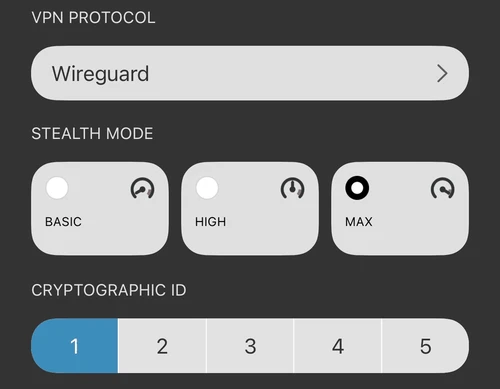
Stealth isn't a separate app or a manual configuration - it's a setting right inside the Le VPN app. Pick your level: Basic for everyday networks, High to obfuscate the packet headers, or Max for full stealth, disguising the handshake and the entire tunnel.
Below it sits the Cryptographic ID selector - your five personal key pairs. Each ID connects with a different cryptographic identity, so if a censor ever interferes with one, tap the next and you're back online in seconds.
What makes Le VPN's Stealth different
Obfuscated handshake
The connection setup - the moment censors most often strike - is padded and disguised so DPI systems never see a VPN handshake happening.
Obfuscated data tunnel
Beyond the handshake, every packet in the ongoing tunnel is stripped of recognizable VPN patterns. There's no signature left to match, block, or throttle.
5 extra key pairs per user
Each user gets five additional pairs of cryptographic keys, making every connection unique. Censors can't fingerprint one key and block the whole service - or you.
Wireguard speed
Built on Wireguard's lightweight design with no heavy TLS re-wrapping, Stealth delivers near-native speed - fast enough for HD streaming, calls, and gaming.
Proven where it counts
Engineered and continuously tested against the world's most aggressive censorship systems - it works in Russia, Iran, China, and almost everywhere else.
On by default
No configuration needed: our new Windows app connects with Stealth Wireguard out of the box, and it's one tap away in our Android and iOS apps.
Stealth or standard Wireguard?
Both use the same modern encryption - the difference is the disguise. Here's when to pick which. You can compare all of Le VPN's protocols in the full protocol overview.
Use Stealth when
- You're in a country that blocks or throttles VPN traffic, such as Russia, Iran, or China.
- You're on a school, hotel, or office network that filters VPN connections.
- Your VPN connects but keeps dropping, or works over mobile data yet fails on Wi-Fi - classic signs of DPI interference.
- You'd rather not think about it - it's our recommended default, with no meaningful downside.
Standard Wireguard is fine when
- You're on an open, unrestricted network and want the simplest possible setup.
- You're using a platform where Stealth isn't available yet and connect through OpenVPN or Wireguard instead.
Built for the hardest networks on earth
Stealth wasn't designed in a lab against a theoretical censor - it's engineered and continuously updated against the real blocking systems used in Russia, Iran, and China, and it works almost everywhere else VPNs are restricted, from national firewalls to office Wi-Fi.
Censorship systems evolve, and no honest provider will promise a 100% success rate forever. What we do promise: when blocking techniques change, we adapt Stealth to match - and with multiple protocols and 100+ server locations behind it, you always have another way through.
Trusted by 1,000,000+ users
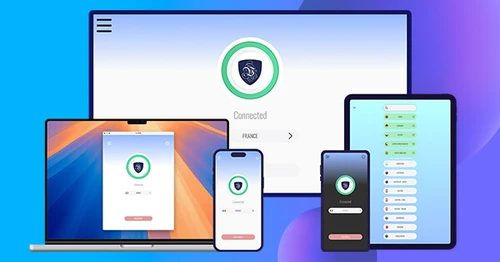
Download the latest Le VPN app for all devices




Download Le VPN for Mac (App Store)
For Apple Silicon and Intel Macs. Learn more about our Le VPN for Mac


Download Le VPN for Linux ( .deb)
For Ubuntu, Debian and Mint. Learn more about our Le VPN for Linux


Also available on routers:

ASUS
WireGuard · OpenVPN

GL.iNet
WireGuard · OpenVPN

TP-Link
WireGuard · OpenVPN

FRITZ!Box
WireGuard

Freebox
WireGuard · OpenVPN

Keenetic
WireGuard · OpenVPN

MikroTik
WireGuard · OpenVPN

UniFi
WireGuard · OpenVPN

Synology
OpenVPN

OpenWrt
WireGuard · OpenVPN

DD-WRT
WireGuard · OpenVPN

pfSense
WireGuard · OpenVPN

OPNsense
WireGuard · OpenVPN
30-Day Money-Back Guarantee
Try Le VPN risk-free! If you're not satisfied within the first 30 days, let us know and we'll refund your money.

Quick recap
Stealth is Le VPN's censorship-resistant protocol, built on Wireguard but with an obfuscation layer that hides both the connection handshake and the data tunnel. To deep packet inspection (DPI) systems your traffic no longer looks like a VPN, so it keeps working on networks that block ordinary VPNs - in Russia, Iran, China, and almost everywhere else - while staying close to native Wireguard speed.
- Defeats DPI and VPN blocks by disguising both the handshake and the full data tunnel, not just the handshake
- Built on Wireguard, so it keeps modern encryption and near-native speed for HD streaming, calls, and gaming
- Each user gets 5 extra cryptographic key pairs, so there's no shared, service-wide fingerprint for censors to block
- One switch in the app: Basic, High, or Max stealth levels, plus a Cryptographic ID selector to rotate keys
- On by default in the new Windows app and one tap away on Android and iOS; standard Wireguard is fine on open networks
- 100+ server locations, up to 10 devices on one account, 30-day money-back guarantee