What is HybridVPN and How It Can Help You
Streaming and security have always pulled in opposite directions. A VPN gives you an encrypted connection, but routing all your traffic through a distant server can add overhead. A SmartDNS unblocks media quickly by redirecting only your location lookups, but it encrypts nothing, leaving the rest of your connection exposed. Most providers make you pick one or the other. Le VPN’s HybridVPN was designed to end that trade-off by combining an encrypted VPN connection with the speed of SmartDNS-style media unblocking.
So What Is HybridVPN and How Can It Help You?
When you connect through a HybridVPN connection by Le VPN, you access the internet through an encrypted, secure tunnel — exactly like a normal VPN connection. The difference is in how media traffic is handled: requests to a list of supported TV channels and streaming services are automatically routed the smart way, at DNS level, so region checks see the right country without your video stream being dragged through unnecessary detours.
In practice, that means you can unblock foreign content — particularly from the US, the UK, and France — that is normally restricted when you access it from outside the country, while everything else you do online stays encrypted. You can see which channels are supported on Le VPN’s SmartDNS channel list.
This is especially useful when you’re travelling outside your own country and want to catch up on your favourite TV shows or sports. Connect once, and your browsing, email, and banking are protected by encryption, while your home country’s streaming services load as if you never left.
Why Not Just Use a SmartDNS?
With a plain SmartDNS, when you access regionally restricted content you sacrifice security entirely: your traffic isn’t encrypted, and your real IP address isn’t hidden. That can be genuinely dangerous on public WiFi zones — hotels, coffee shops, libraries, and airports — where anyone on the network can intercept unprotected traffic.
With HybridVPN, you stay protected while you watch all your missed shows. The secret is that HybridVPN gives streaming traffic a direct, bottleneck-free path — just as a SmartDNS would — while still encrypting the rest of your online activity through the VPN tunnel. Security no longer takes a back seat to speed.
Easy to Use — No Configuration Needed
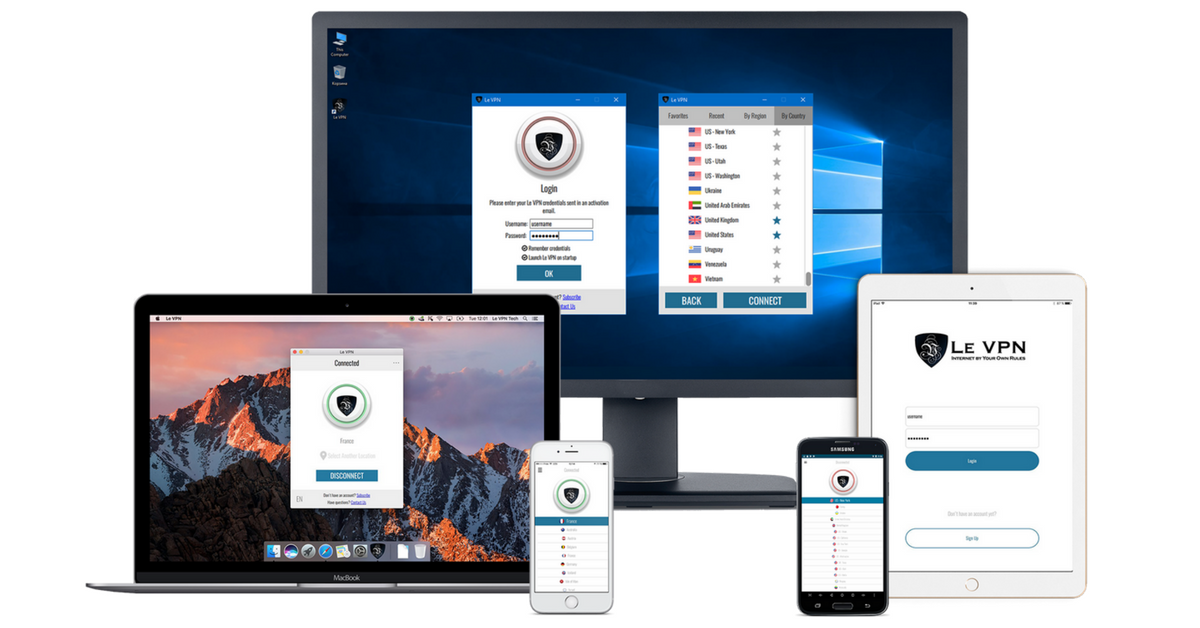
The ease of setup is another reason to choose HybridVPN. There are no DNS settings to change and no complicated device configuration: you simply connect to a HybridVPN server in your Le VPN server list, and the rest is taken care of. It works within the normal Le VPN apps for Windows, macOS, iOS, and Android, and one account covers up to 5 devices simultaneously.
For devices that can’t run VPN software at all — some smart TVs and games consoles — Le VPN’s SmartDNS can be configured directly on the device or router for DNS-level unblocking, though remember it doesn’t add encryption on its own.
Part of a Complete VPN Service
HybridVPN is one piece of what you get with a Le VPN subscription:
- Servers in 100+ locations across the Americas, Europe, the Middle East, Asia-Pacific and Africa — browse the full server list.
- Modern protocols — OpenVPN, WireGuard, Stealth WireGuard, and IPSec/IKEv2 — for a fast, secure connection on every device.
- Reliable streaming know-how. For UK television, any Le VPN UK server works for BBC and ITV; specialist servers cover trickier services. And one honest note: the biggest platforms, like Netflix, actively detect VPN and DNS unblocking, so if a particular service resists, switching servers is often all it takes.
- Anonymous browsing. Your real IP address stays hidden — verify it any time with the IP address test.
- A 30-day money-back guarantee on your first purchase.
With constant stories about hacking and data theft, nobody can really afford to use the internet without good security — and with so much regionally restricted content worth watching, nobody wants to give up streaming either. With HybridVPN, you don’t have to choose. Sign up to Le VPN today and enjoy the true freedom of the internet and strong security — at the same time.