Blizzard Censorship: How to Unblock Games and Where?
The Blizzard censorship scandal of 2019 remains one of the clearest lessons the gaming world has ever received: restrictions on content and free speech can cross from the online world into real life in the blink of an eye. Years later, the pattern it exposed hasn’t gone away - it has become the norm across gaming, streaming, and social media.
Focusing on Activision Blizzard, or any single company, misses the point. Publishers will do whatever it takes to protect revenue in every market they operate in, and moral principle rarely survives contact with a large market’s demands.
What we should focus on instead are the ways we can reach the games we want, consume media, and communicate freely. Gaming is one of the best examples of people connecting without bias - in-game, your gender, race, ethnicity, or class counts for nothing; only how well you play. Protecting that space is worth some effort.
Ironically, the best way for your voice and your wallet to be heard is often to be anonymous: usernames, pseudonyms, gamer tags - and a masked IP address. With a premium VPN provider like Le VPN, you can choose from servers in 100+ locations, protecting your identity at home while letting you experience regional content and markets the way locals see them.
What Did the Blizzard Scandal Show?
Those of us living online tend to forget how censorship works in the real world. Our usual complaints are about cut game content or a show being banned somewhere.
In 2019, the impact got much more direct. Professional Hearthstone player Blitzchung voiced support for the Hong Kong protests during a post-match interview - and lost his winnings and his livelihood for purely political reasons. The prize money was later returned under international pressure, but a lengthy competitive ban stood. Blizzard even canceled an Overwatch launch event amid the backlash, fearing protest imagery - including fans planning to dress as Winnie the Pooh, a reference to a meme mocking China’s president.
The episode showed that censorship follows into the real world as fast as it spreads online, and that punishment can arrive even in countries regarded as free and democratic. Players and creators who aren’t careful with their identity can find themselves penalized for opinions that have nothing to do with the game.
Reasons for Censorship
Most people know about censorship in China or Russia and assume it’s a cultural issue. It isn’t. Censorship happens all over the world, and virtually all of it comes down to two things: money and control. The Blizzard case involved both.
Companies want money and will bend rules and good practice to keep large markets happy - serving shareholders is every company’s primary goal. Governments want control, and even in democratic countries the apparatus of content regulation keeps growing; only the people running it change.
1. Global Community Standards
A phrase that would have meant nothing two decades ago is now a main reason developers, publishers, and even individuals crop their own expression. The logic: somewhere, someone might be offended - so content gets sanitized globally, not just where complaints originate. Social media outrage campaigns regularly push publishers into worldwide edits.
VPN users notice that local markets differ substantially: different merchandise, different content edits, different community rules. Exploring regional versions of games and media is often the only way to see the work as originally intended.
2. Licensing and Intellectual Property Rights
Licensing isn’t censorship in intent, but the result is the same: you can’t watch or play what you want. Content can wait years for a local distributor, or never get one. Anyone with a VPN knows streaming catalogs differ dramatically between countries - shows freely available in the UK may be missing in the US simply because nobody licensed them there.
3. Politics, Religion, and Culture
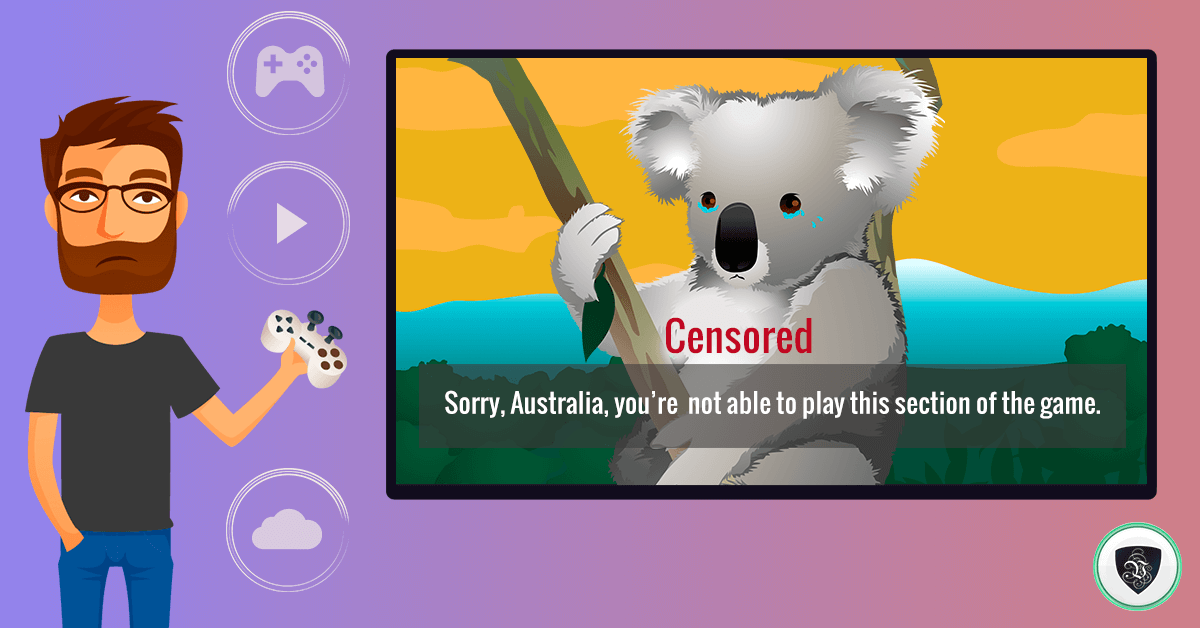
Some content is banned outright by law. This type of internet censorship is most prevalent in autocratic countries. Many Middle Eastern countries have strict laws on religious representation - games featuring magic, witchcraft, or fantastical polytheism can be banned. Parts of Asia enforce stricter political rules. And violence triggers bans or forced edits in several markets; Australian gamers have long dealt with heavier content restrictions than most of the English-speaking world, to the point where games have joked about it - South Park famously replaced censored content with a crying koala.
4. Corporate Control
Corporations want their content widespread, non-offensive, and controlled at all times - a tendency amplified by the games-as-a-service model, where the publisher can alter or remove content you “own” at any moment. As in the Blizzard case, companies will also suppress discussion that could hurt the brand, from moderated forums to search and platform-level filtering.
5. Social & Political Control
Finally, the original reason for all censorship: control. The Blizzard scandal happened because a government didn’t want anyone discussing protests. Other governments block other discussions. Even where a justification sounds reasonable - Germany’s historical restrictions on Nazi imagery in games, for example - the argument stays flawed: taboo only sharpens curiosity, and without open discussion and context, ideas are more easily misconstrued, not less. That’s why being able to unblock games, films, shows, and foreign forums matters - it’s the only way to see the whole cultural picture.
How to Avoid Censorship?
Avoiding censorship is a two-part process: reaching foreign markets and content, then participating - buying, playing, speaking. There’s no downside to exploring; you experience the full version of the media and become both better protected and better informed.
1. Use a VPN
A virtual private network masks the IP address assigned by your ISP, encrypting your traffic inside a tunnel to a protected server. Beyond privacy, “virtual traveling” - accessing geo-restricted content - is one of the most popular uses of a VPN.
The key is avoiding unreliable free VPNs and shady proxies. Le VPN offers servers in 100+ locations, modern protocols including WireGuard for speed and Stealth WireGuard for networks that actively block VPN traffic, apps for every major platform, and up to 10 simultaneous connections per account.
2. Access Foreign Markets
With a gaming VPN, you can browse regional stores, see region-specific content, and even play on multiplayer servers in other countries - picking a server close to the game region keeps ping low. The more people engage with open markets, the harder it becomes for publishers to keep regions artificially walled off.
3. Vote with Your Wallet
Money talks. Companies work for profit, and censorship decisions are ultimately cost-benefit calculations - the Blizzard backlash proved scandals have a price. Buying the media you actually want, from markets that offer it uncensored, is a small individual act that adds up to real market pressure.
4. Speak Your Mind
Free speech is like a muscle: unused, it atrophies. Unlike in the past, you can now exercise it without exposing yourself to retaliation - behind an avatar, with your IP address hidden. You can be cordial and thoughtful while pseudonymous; nobody needs to suffer Blitzchung’s fate for an opinion.
5. Stay Anonymous
Becoming anonymous is easy: turn on your VPN and pick a pseudonym. Staying anonymous takes discipline - good cyber hygiene across all your devices, especially your phone. Consider separating your social media presence: one clean account under your real name for family, and a pseudonymous one for browsing, forums, and commentary, with no name, face, or personal details. Connect through the VPN for both.
The Bounty of Local Online Markets
Every region produces something hard to find anywhere else - games, shows, films, comics. Much of it now ships with subtitles or dubs in English, French, Spanish, and German if you dig a little.
- North America & Australia: Quebec's French-only shows, the huge US streaming catalogs, and Australian TV drama that deserves a global audience.
- Latin America: telenovelas from Mexico, Argentina, and Brazil - easy drama with entertaining twists, mostly locked to the region.
- Europe: every country has its own film and TV production, from British sci-fi to French romance to Italian social commentary - much of it never exported.
- Africa: Uganda, Nigeria, and Cameroon have thriving movie industries ("Who Killed Captain Alex" opened the world's eyes) that barely distribute abroad.
- Asia: Japanese manga and anime, Korean dramas, Southeast Asian games - vast markets largely focused inward, full of gems for anyone willing to look.
Conclusion
The Blizzard censorship affair shouldn’t push anyone to abandon gaming. It should reaffirm what we already knew: stay anonymous and keep your options open if you want to enjoy your media freely.
With a premium VPN provider like Le VPN, you can travel the world from your own couch - unblocking games, shows, and conversations that would otherwise be walled off - with a 30-day money-back guarantee on your first purchase if you want to try it risk-free.
About the author

Guest Author
Vuk Mujović is the founder of MacTíre Consulting, an analyst, data management expert, and a long-term writer on all things business & tech. He authored blogs, articles, and opinion pieces aimed to help both companies and individuals achieve growth without compromising their security.
Articles by Vuk Mujović →