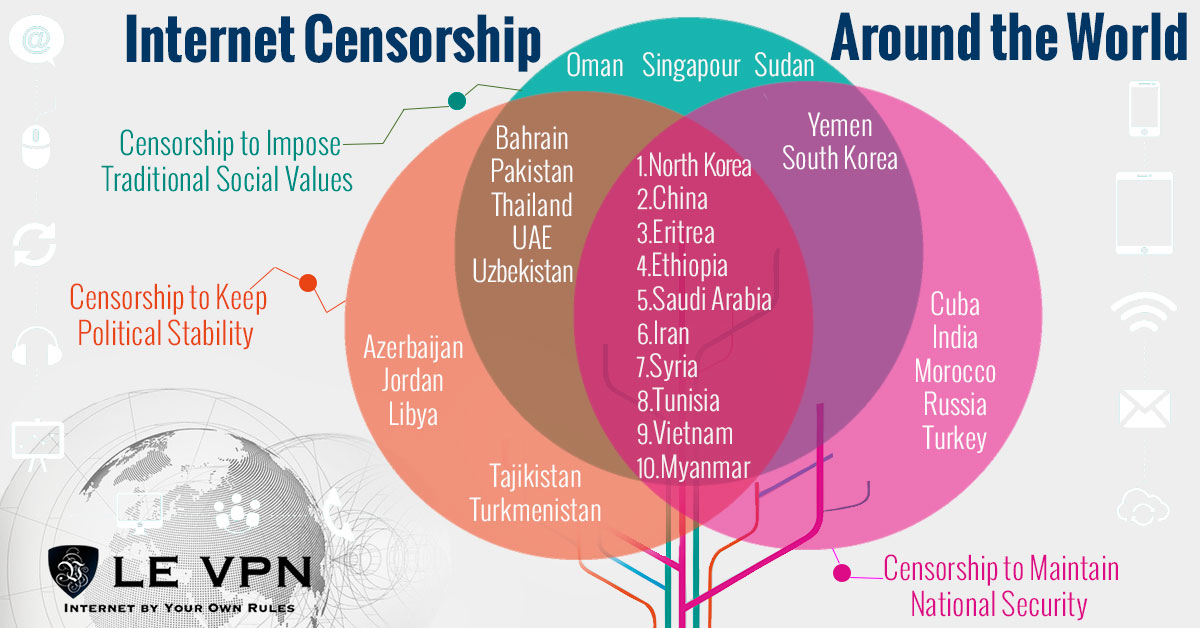
What is internet censorship and why it exists
What is internet censorship, who imposes it, and why? Understanding the mechanics and the motives is the first step toward getting around it — whether you live under heavy restrictions or you’re just traveling somewhere that filters the web.
What is censorship?
Censorship is the suppression of speech or other public communication considered objectionable, harmful, sensitive, or inconvenient by a government, media outlet, or other controlling body. The control of information and ideas circulating within a society has been a hallmark of authoritarian rule throughout history. In the last century, censorship worked through the examination of books, plays, films, television and radio programs, and news reports, altering or suppressing whatever the censor found objectionable.
Not all censorship looks the same. One especially insidious form is meta-censorship: censoring the very existence of censorship. Under meta-censorship, the legal basis for blocking is hidden, the rules of censoring are classified, and removed texts are not marked — so citizens can’t even see what they’re not seeing.
What is internet censorship?
Internet censorship is the control or suppression of what can be accessed, published, or viewed online, enacted by governments and regulators — or by companies and individuals on their own initiative. People and organizations also self-censor for moral, religious, or business reasons, to conform to social norms, or out of fear of legal and other consequences.
In practice, internet censorship today operates through a toolbox of techniques:
- DNS and IP blocking — the simplest method: your ISP refuses to resolve or route to a banned site.
- Deep packet inspection (DPI) — network equipment examines traffic itself and blocks whole categories, including VPN protocols, in real time.
- Throttling — instead of a clean block, a service is slowed until it's unusable, which is harder to prove and protest.
- Platform pressure and content removal — governments compel platforms to delete posts, deplatform users, or localize data.
- Full shutdowns — in extreme moments, entire regions are simply cut off from the internet.
The scale varies enormously by country, culture, and context — from narrowly targeted blocking of clearly illegal material to sweeping suppression of independent news, social media, and messaging apps.
Why does internet censorship exist?
Motivations differ from country to country, but researchers have long identified a set of justifications that recur almost everywhere:
- National security — weapons-making instructions, illegal drugs, and protection from terrorism
- Protection of minors — abuse, exploitative marketing, violence, and pornography
- Protection of human dignity — incitement to racial hatred or discrimination
- Economic security — fraud and payment-card piracy
- Information security — malicious hacking
- Protection of privacy — unauthorized sharing of personal data, harassment, spam
- Protection of reputation — defamation and unlawful comparative advertising
- Intellectual property — unauthorized distribution of copyrighted music, software, books, and films
Some of these aims are legitimate — every country polices genuinely criminal content. The problem is that the same infrastructure built to block the indefensible is easily repurposed to block the merely inconvenient: opposition news, protest coordination, foreign media, or entire social networks. Once a national filtering system exists, the list of banned material tends to grow, and the categories blur. “National security” becomes a label applied to journalism; “protecting public order” becomes a reason to silence dissent.
That’s why censorship intensity tracks so closely with political systems. In heavily censored countries — China, Iran, Russia, Myanmar and others — filtering extends far beyond illegal content into the routine suppression of information the government dislikes, often combined with surveillance of who tries to access it.
How to bypass internet censorship
A VPN is the most practical tool for reclaiming an open internet. It encrypts your connection and routes it through a server in another country, so local filters can’t see what you’re accessing and can’t block it based on content or destination.
Le VPN is built for exactly this. You get servers in 100+ locations across the Americas, Europe, the Middle East, Asia-Pacific and Africa, so there’s always an uncensored exit point nearby. Your connection is protected by strong encryption, which also keeps you safe on public Wi-Fi in airports, cafés, and hotels — networks where snooping is easiest.
Crucially for censored countries, Le VPN offers Stealth WireGuard, an obfuscated protocol that disguises VPN traffic so it can pass through deep packet inspection. Where standard VPN protocols are detected and blocked, Stealth WireGuard lets you connect anyway — it works in heavily censored countries such as Russia, Iran, China, and Myanmar.
Two practical tips:
- Install before you travel. VPN provider websites are often blocked inside censored countries, so set up Le VPN on your devices while you still have open internet. One account covers up to 5 simultaneous connections.
- Verify your connection. Use the Le VPN IP test page to confirm the world sees the VPN server's address, not yours.
Discover more about how to counteract internet censorship on the Le VPN blog — and make sure you can bypass internet censorship wherever you are, with the internet working by your rules.