First suspension of internet access in France due to Hadopi
In June 2013, France made internet history for an uncomfortable reason: for the first time since the Hadopi law came into force, a French court actually ordered an internet user’s connection to be suspended. The district court of Seine-Saint-Denis sentenced the user to a 600-euro fine and a two-week suspension of his internet access - the harshest penalty ever handed down under France’s “graduated response” system against illegal file sharing.
That case became a landmark, and it is worth revisiting - both for what happened to Hadopi afterwards, and for what it still teaches about how much of your online activity is visible to your internet provider and to monitoring agencies.
What was the Hadopi law?
Hadopi - the Haute Autorité pour la diffusion des œuvres et la protection des droits sur Internet - was the French agency created to fight copyright infringement online. Its signature tool was the “graduated response”: a subscriber suspected of infringing downloads (or simply of failing to secure their connection) would first receive a warning email, then a registered letter, and only after repeated notices could the case go to court, where fines and, at the time, suspension of internet access were on the table.
The suspension penalty was controversial from the start. Internet service providers argued it was technically complex to implement, since the operator still had to preserve the user’s email and phone service. Digital rights advocates argued that cutting someone off from the internet was a disproportionate punishment in a connected society. In the end, the critics largely won: the suspension penalty was abolished just weeks after that first sentence, in July 2013, leaving fines as the main sanction.
Where is Hadopi now?
The agency itself no longer exists under that name. In 2022, Hadopi was merged with France’s broadcasting regulator into a single body, Arcom, which inherited the graduated-response system. The warning letters still go out - millions have been sent over the years - and copyright enforcement online has, if anything, become more organised across Europe, extending well beyond P2P networks to streaming and mirror sites.
The underlying mechanism has not changed: monitoring agencies observe public file-sharing networks, record the IP addresses they see, and match them to subscribers through the ISPs. Everything rests on one identifier - your IP address - and on the fact that your traffic is visible to your provider.
What this story teaches about online privacy
The Hadopi saga is a concrete demonstration of something many people only understand in the abstract: without protection, your internet connection is not private. Your ISP can see what you do; third parties can log your IP address; and legal or administrative consequences can follow from that visibility, sometimes even when the account holder was not the person at the keyboard - “failure to secure your connection” was itself grounds for a Hadopi warning.
This is precisely the problem a VPN was designed to solve.
How a VPN protects your connection
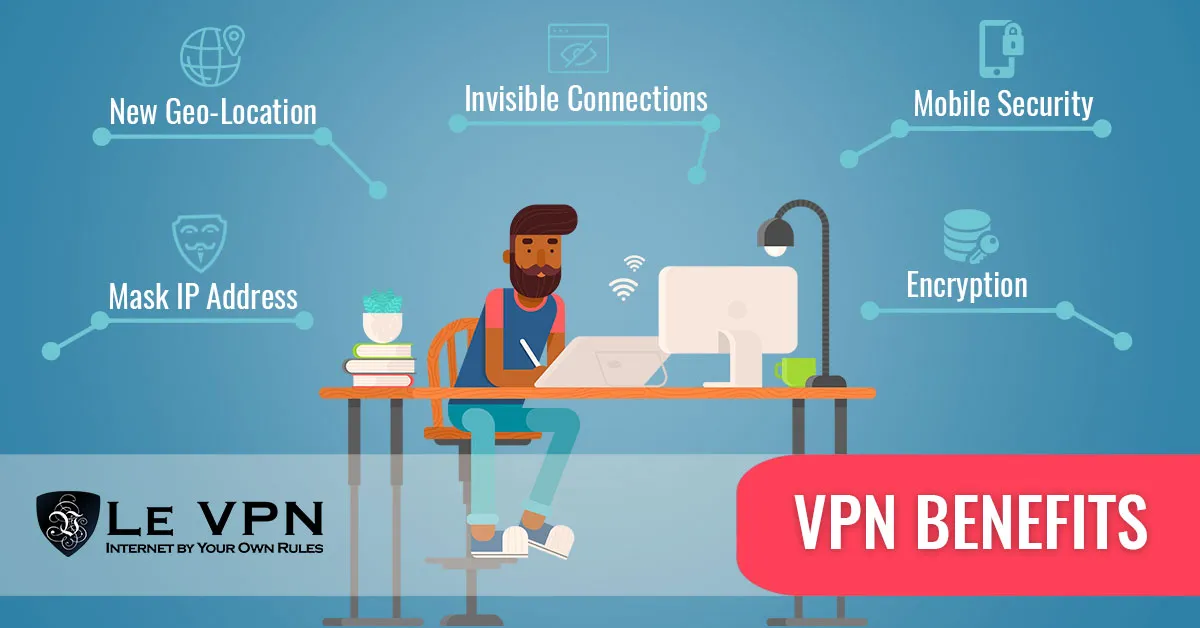
When you enable a VPN service, your device no longer connects to websites directly. Instead, all your traffic travels through an encrypted tunnel to a VPN server, using strong AES-256 encryption. Two things follow:
- Your ISP cannot inspect your activity. The provider sees only encrypted data flowing to a VPN server - not which sites you visit, what you stream, or what you transfer. Deep packet inspection reveals nothing usable.
- The outside world does not see your IP address. Websites and third parties see the VPN server's address instead of yours. With Le VPN you can choose that address from servers in 100+ locations across the Americas, Europe, the Middle East, Asia-Pacific and Africa - see the server list, and check what the internet sees with the IP address test.
The protection is independent of which applications you use: the VPN operates at the connection level, covering your browser, your email client and any other software, on Windows, macOS, iOS and Android alike. One Le VPN account protects up to 10 devices simultaneously, and you can pick from modern protocols - OpenVPN, WireGuard, Stealth WireGuard and IPSec/IKEv2 - with WireGuard offering excellent speed and Stealth WireGuard adding obfuscation on networks that restrict VPN traffic.
None of this is a licence to break the law - copyright rules apply whatever tools you use, and respecting them is your responsibility. But the Hadopi story shows how thin the wall is between your online activity and those watching it. A VPN rebuilds that wall: it keeps your browsing, streaming and file transfers between you and the encrypted tunnel, reduces the trail of IP-address records you leave across the internet, and shields you from indiscriminate monitoring on any network, public or private.
Your connection, your business. Get Le VPN - every first purchase is covered by a 30-day money-back guarantee - and browse with your privacy intact.
About the author
Le VPN Blog Editor
Alan Summers has been writing and editing for the Le VPN blog for years, covering online privacy, cyber security, and the best ways to get the most out of a VPN. He keeps a close eye on the news that affects internet freedom around the world and turns it into practical advice for Le VPN readers.
Articles by Alan Summers →